Showing posts with label 15 second review. Show all posts

Saturday, 2 September 2017

15 Second Review: Malady (2015)

Malady is a tricky film to review for several reasons. First, it is a slow burning mystery film, and so revealing too much about the plot – which is fairly sparse in terms of story “events” – would ruin the movie. Second, Malady is intentionally enigmatic. It is built on concepts and fleeting impressions more than hard plot-points. The characters project their desires onto substitutes (such as a ring, a lock of hair, or even another person), and so those symbols carry much of Malady’s meaning. To pin-down what happens in Malady is akin to describing a dream; a description would sound vague and it would do no justice to the richness of experiencing it first-hand.
There is little dialogue particularly in the first third of Malady (my favourite part of the film), precisely because words fail to capture experiences such as grief and desire. Throughout, back-story events and motivations are hinted at without being laid out. The narrative is comprised of echoes such as, for instance, an equivalence between lead protagonists Holly and Matthew’s situations vis-à-vis devotion to their ailing mothers. There are dozens of such strands woven into Malady, but they are indirect and therefore somewhat indistinct. This is not a complaint; the movie has been edited into its leanest possible form (both at script and post-production stages), and that  only benefits the final product. The viewer is left with gaps to fill, but that technique develops the atmosphere and focuses one’s attention. The filmmakers and cast provide sufficient detail so that one can always at least sense what had happened prior to the narrative present. Malady seeks to form a pact with its audience based on trust; the viewer’s trust in the filmmakers’ judgement, and the filmmakers’ trust in the viewer’s intelligence. That pact parallels the film’s themes insofar as Holly’s wholesale commitment to Matthew – her trust in someone she hardly knows – leads her (and the audience) into dark territory.
I presume the film was shot on a micro-budget; the credits make reference to crowd-funding, and a small crew were responsible for the production. However, the film itself bears little evidence of its financial origins. I sincerely doubt that a higher budget would have enhanced the content. The movie boasts an assured aesthetic that matches its patient pace. There is a maturity and confidence to the proceedings that are vital to selling what could have easily come off as pretentious, boring or frustrating in lesser hands. The production undoubtedly benefitted from writer/director/producer/editor (…and so forth) Jack James’s evident control over the project at all levels. It feels like an intimate project from the ground up, and the cast give appropriately assured performances as a result.
I have no doubt that Malady will struggle commercially because it does not neatly fit into a genre category. Its pacing (and some of its more controversial themes) will undoubtedly alienate some viewers. However, those who do discover this gem will be rewarded with an involving, impressive and haunting feature that certainly ranks among the best indie movies in recent memory, and which holds its own against its higher-budget brethren.


Tuesday, 28 March 2017

15 Second Review: The Dark Tapes


The Dark Tapes is a horror anthology film, and as with any compendium, the segments that comprise the whole are somewhat hit-and-miss. “The Hunters and the Hunted” is the most complete story, and certainly boasts some of the best performances; “Amanda’s Revenge” has a neat structure that initially misdirects the viewer in a highly effective way; “Cam Girls” is the weakest section, featuring some unconvincing acting and the least satisfying plot overall. Nevertheless, each section is efficient, which will surely please viewers who are bored by the protracted establishing sequences that bog down so many full-length found-footage movies. The Dark Tapes has been edited with care, giving enough information to guide the viewer, but refraining from bloating the script with needless exposition. My main problem with the film is that the stories include various plot holes and logical inconsistencies (which I cannot explain here without spoiling each segment), which detracts from the realism that found-footage relies upon. Still, the film is ambitious, and although the wrap-around story does not connect the others together in a literal fashion, it does offer a set of conceptual, thematic links that are intriguing. The opening declaration that ‘humanity is getting closer to the truth’ frames the film’s events as if they are genuine, or at least as if the footage reveals some kind of authenticity. Yet, the film also wears its artifice on its sleeve, flagging that its apparent veracity is entirely fabricated. In that sense, it could be argued that the logical inconsistencies buried within the individual stories enhance the film’s dualistic approach to found-footage. On one hand, The Dark Tapes typifies the found-footage subgenre, replicating the visual tropes – such as ‘digital glitches’ – that have become synonymous with such movies (even though these glitches are unrealistic, inasmuch as they are incredibly rare outside of the subgenre). The film also recalls established found-footage touchstones, including overt nods to V/H/S (in terms of its multiple story structure), and echoing Paranormal Activity in the segment “The Hunters and the Hunted”. However, not only is that parallel to Paranormal Activity undercut in the story itself (I will not say any more so as not to spoil), but it is notable that the makers of The Dark Tapes are just as comfortable citing other horror influences, including Poltergeist (in the “The Hunters and the Hunted”), and even A Nightmare on Elm Street (in the segment “Amanda’s Revenge” via the refrain ‘Don’t fall asleep’). These references root the movie in a broader canon of horror history that extends beyond the recent trend for found-footage indie-flicks. In sum, although The Dark Tapes has its flaws, it is an intriguing film that seeks to rise above the crowd, and I would much rather watch an imperfect movie that attempts to do something interesting than a technically exquisite but banal one.  

Saturday, 17 September 2016

15 Second Review: 31 (2016)

I understand why so many critics are disappointed by 31, but it is nowhere near as bad is being suggested. The movie is ultimately a decently made torture porn flick (NB: if you read that sentence as an insult, then allow me to direct you here). The main issue with 31 is that the plot is so paper-thin that the movie feels hollow, even flat. However, let’s put this in perspective. 31 is still more entertaining than most other movies that share the same plot ($la$hers [2001], for instance), and it is more coherent than Zombie’s debut House of 1000 Corpses, or even Halloween II. Thin plot might be a sensible route for Zombie given that storytelling is not his forte. As I have come to expect from Zombie, the direction is inconsistent, shifting between strong compositions and floundering disarray. The core problem here is shaky cam – a.k.a. the trend that refuses to die, a.k.a. the worst thing to happen to filmmaking – which amplifies the impression that the film is a wild, unfocused jumble of “stuff”. Obviously Zombie should not be singled out here, since so many directors seem enamoured with the technique, even if it means refusing to show the audience what is happening and hampering immersion. Nevertheless, it is frustrating to know that Zombie is capable of much better, as Lords of Salem demonstrates. It is also telling that by far the strongest sequence in 31 is the opening monologue, which is almost entirely constituted by a single static extreme close-up. Richard Brake steals the movie, both because it is a great performance and also because Doom-Head is the film’s only real character. The casting, it should be noted, is one of the movie’s highlights. It was particularly refreshing to see actors such as Lawrence Hilton-Jacobs and Meg Foster in roles that would typically be occupied by “pretty” 19 year-olds. In sum, this is a step backwards for Zombie after Lords of Salem, but unevenness is the hallmark of his oeuvre. If he stays true to form, his next movie will be a treat.

Monday, 1 August 2016

15 Second Review: Natalie's Lose Lose

Natalie’s Lose Lose (2012) is a no-budget horror film that succeeds on a couple of fronts. First, unlike so many other ultra-low budget films, the performances are generally solid here. Second, the direction is well-judged; the tight close-ups create a claustrophobic atmosphere and even manage to mask some of the budgetary shortcomings that would otherwise be evident in the set-design, costuming and so forth. However, while Natalie’s Lose Lose prospers in areas where others flounder, it struggles when it comes to delivering the most essential aspect: its story. With a running time of only 80 minutes the film ought to feel brisk, yet it drags. Natalie’s Lose Lose is illustrative of a problem with feature filmmaking; if it had been viable to release the film as a 45-minute piece, it could have been edited into a taught, exciting tale. As it stands, it is bloated. The main reason it feels so sluggish is that the film is mainly constituted by dialogue. As a movie that clearly draws on the torture-horror boom of the era, it really ought to have contained more torture. The problem is not a lack of violence per se; after all, many reviewers complain about being “bored” by torture porn’s “endless” agony. Rather, some threat is needed in order to motivate the eponymous protagonist. Natalie never seems fazed by the challenges she faces, and that makes it hard to empathise with her situation. She just does not seem to care that she has been kidnapped. Perversely, one of the overarching reasons that Natalie’s Lose Lose is so uninvolving is that there is also no hope for the protagonist, however stoic – perhaps even blasé – she is about the whole affair. As the title overtly states, Natalie is in a “lose-lose” situation. Consequently, the narrative comes across as an exercise in prolonging the inevitable, offering no hint that Natalie might escape her fate (or indeed, that she will even bother to try). The most fundamental problem, however, is that the narrative ultimately makes little sense. The film offers a final “twist” in order to explain why the abductors would have motive to kill Natalie, but they are given no incentive to question or torment her. Since the film is entirely constituted by questioning and tormenting Natalie, the “twist” renders the film’s content redundant. Unfortunately, watching this movie is a “lose-lose”.

Wednesday, 20 July 2016

15 Second Review: Hope Lost

Hope Lost (2015) draws on a premise so familiar that I genuinely spent the first 20 minutes questioning whether I had seen the film before. The story is a mishmash of clichés about sex trafficking rings, treading a path already taken by Eden (2012), Human Cargo (2011), Sweet Karma (2009), Slave (2009), Shuttle (2008), Trade (2007), Holly (2006), and numerous other horror/thrillers during the last decade. Even the cast list (Danny Trejo, Michael Madsen, Daniel Baldwin) reads like a warning that the film is likely to be generic. Yet, amidst its barrage of predictable, unpleasant, and admittedly effective incidents, Hope Lost has a trump card. It does not need an original storyline, because this is a concept movie. The conceit is revealed in the opening, during a scene that takes us to the film’s final set-piece; in voice-over, Gabriel (who is later revealed to be a snuff film director), states that ‘one of the golden rules of cinema’ is that ‘before inevitable doom, there must always be a scene of hope’. This is exactly what the film delivers across a series of increasingly grim events, each of which is preceded by a glimmer of hope: potential escapes, attempted rescues, promise of “a new life”, and so forth. Of course, all are thwarted, as Gabriel promises. None of this is surprising, given that the film is entitled Hope Lost, and we have already glimpsed the protagonist’s fate during the opening seconds. What is notable, however, is that the film is so relentless in its pursuit of this conceit and so irrepressibly bleak. This combination leads to a single question: why would anyone watch such a movie? This meta-commentary is presaged by the overtly cinematic language advanced by Gabriel, the director of the film-within-a-film. The lead protagonist suffers endlessly here, but the film is not designed to make her torment pleasurable for the audience: that is another cliché, one that is proposed by critics who fail to understand the genre. Pleasure stems from rooting for an ordinary person as they attempt to conquer extraordinary adversity. This is the ‘hope’ referred to in the title Hope Lost. It is such a powerful compulsion that, as Hope Lost demonstrates, the filmmakers can rely on the audience to keep hoping, no matter how unreachable the goal appears to be, how often hope is snatched away, or how blatantly the character’s fate is signalled. Hope Lost has its flaws, but the filmmakers’ insistent adherence to the core concept is admirable. 

Sunday, 17 July 2016

15 Second Review: Marble Hornets

Marble Hornets is a found-footage web series comprised of 87 entries (or 133 videos, all told) that were originally uploaded to two separate YouTube channels between 2009-2014. One, the ‘Marble Hornets’ channel, hosted the main narrative. The second channel ‘ToTheArk’ uploaded sinister responses to the main entries. The series is split into three seasons of varying length, and the whole saga lasts nearly 91/2 hours. The no-budget series gained attention by becoming an early adopter of the Slenderman mythos, and for offering numerous secret messages (such as flash-frames of numbers that were avidly decoded by a Reddit group). Its success was also helped by the first few hours of footage, which are genuinely unsettling. On paper, the series replicates the techniques offered by other found-footage films such as Noroi (2005), for instance. However, the series benefits from the filmmakers’ inexperience; frequently, the early episodes feel “edgy” because they are made by people who do not quite follow standard filmmaking conventions. Consequently, as the tension rises, it feels like pretty much anything could happen next. Unfortunately, that feeling dissipates before the first season closes. The second series has an interesting premise – filling in details of seven months that the protagonist (Jay) cannot remember – but the series loses its unpredictability, becoming entirely formulaic. Virtually every episode in the season consists of the protagonists travelling to a location and spotting Slenderman (here referred to as ‘The Operator’) as the tape becomes corrupted. The second season also shows ‘The Operator’ too much, and so his presence loses impact. The first season makes effective use of Slenderman’s distinctive look by placing him in the background or in the corner of a frame during a pan; he is there, but only for an instant, and that is much more ominous than seeing Slenderman stood around directly in front of the camera. Perhaps the filmmakers also became more comfortable with how to film the series. The material feels “safer” than the early entries, in spite of the more overt threats faced by the protagonists. The filmmakers also rely on dialogue-heavy scenes in the second season. This was an unwise move as the lead performers – creators Joseph DeLage and Troy Wagner – are not up to the task (DeLage’s performance is particularly stilted). The latter problem continues into the third season, and by the seventh hour I was really wishing that they would start tying up the plot rather than stringing it out. It is also a shame that the final episodes were anti-climactic. Still, there are some nice moments buried in the running time for those willing to engage with it, and the makers should be congratulated for what they achieved with virtually nothing. The whole series is still available on YouTube (one user has kindly compiled a playlist of all the episodes in order for lazy folks like me), and the first two hours are certainly worth a look. I would advise digging into the message boards about the series in tandem to watching each entry: the enthusiasm with which new episodes and fragments of information were greeted by fans is more intriguing than the events depicted in the series itself.


Tuesday, 12 July 2016

15 Second Review: Ghostbusters (2016)

Ghostbusters is finally here, and it is exactly what it should be: a fun and funny movie. I mean that in the best possible way. Does anyone want a serious, thought-provoking Ghostbusters? I sure as hell don’t. I want to be entertained, and Ghostbusters absolutely delivers. The film zips along at a well-judged pace; it does not seem rushed, but it also does not feel like a two-hour movie. The script is a hoot, the story is appropriately cartoonish, and the cast are well-suited to their roles. The film’s secret weapon, however, is Kate McKinnon’s performance as Holtzmann. McKinnon manages to steal every scene she appears in – I mean that literally; every damn scene – and that is a truly impressive feat given the comic talent involved in this film. Is Ghostbusters perfect? Of course not; some of the jokes don’t land; the cameos are forced; and there are moments where the CG doesn’t quite work (in fact the “green screen” is apparent at several points during the climax). Was it “as good as the original”? What a stupid question. I have seen the predecessor dozens of times, and my fondness for it has been cultivated gradually over the last thirty years. No new Ghostbusters film could hope to dislodge my nostalgia goggles. On initial viewing however, I enjoyed the 2016 iteration of Ghostbusters much more than I have ever enjoyed Ghostbusters 2. I sincerely hope that the kids seeing this new Ghostbusters will come to regard it with the same affection that so many children of the 80s have for the original. Don't listen to the haters, Ghostbusters is a blast. 

Monday, 11 July 2016

15 Second Review: The Lesson (2014)

First, I ought to clarify that this review is about Kristina Grozeva and Petar Valchanov’s The Lesson, not Ruth Platt’s The Lesson. I saw both in close proximity, and Platt’s film really did not cut it for me (so I'll say no more about it). Grozeva and Valchanov’s film, on the other hand, is a meticulously constructed tale. I have not felt so frustrated for a lead protagonist since watching Oliver Stone’s U-Turn (1997). As with Stone’s movie – and this is the only salient point of comparison – The Lesson’s central protagonist faces a n unrelenting series of misfortunes. Individually, most of the mishaps are relatively minor, but cumulatively they are torturous: I spent most of the film desperately yearning for one of the protagonist’s efforts to pay off. I will not reveal whether she ultimately succeeds or not (as that would spoil the “fun”). However, I will say that while the climax is somewhat outlandish, the final scene is an understated black comic masterstroke: not only did it make the slightly implausible precursor palatable, but it also offered a neat reward for making it through two excruciating hours of escalating calamities. The performances and cinematography are restrained, and that only adds to the film’s constricted atmosphere. Recommended, but only for those willing to hold their nerve for the movie's wry "lesson".

Thursday, 31 March 2016

15 Second Review: Faces of Snuff (2016)

Faces of Snuff is difficult to contextualise since the film has no credit sequences (at least in the version I saw). There is a website associated with the film, but it contains no identifiable production information (at the time of writing). The film itself is a compilation of unrelated clips, each of which is snuff themed. As the title suggests (with its direct reference to Faces of Death (1978)), this is the faux-snuff equivalent of the mondo film. The premise works well given the crossovers between mondo and pseudo-snuff, both of which typically include ostensibly real death footage.
The implicit question haunting Faces of Snuff is whether any of its footage is genuine. Most of it (as with Faces of Death) certainly is not. Some of the sequences are clearly staged, and some of the acting is unconvincing (although those sequences highlight just how realistic other parts of the film are). Other segments have overt narrative arcs and even “twist” endings. There are also some familiar faces here; some clips are derived from existing faux-snuff films, and a public information film provides a leitmotif throughout: I won’t name these familiar assets here, since identifying them will be part of the fun for fans of the subgenre. Still, the inclusion of pre-existing footage  - which is one of the mondo film's common tropes - and the lack of credits might suggest that this is a compilation of clips sourced from the web (as with MDPOPE (2013)), and in that case there is a possibility that some of the footage might display genuine death, even if that was not the compiler’s intention. Again, despite my natural scepticism, the room for doubt is part of what makes such films (and the snuff mythos) intriguing.  
What I will say is this: the compilation certainly hasn’t been pieced together in a sloppy, accidental fashion. Faces of Snuff has a clear internal logic. I doubt that the film has been created by a single director since it appears that while most of the footage is American, some has been sourced from other countries (one being the UK). Yet the film has been arranged by individual/s who understand how to carry the viewer through a compilation that is over two hours in duration. The film encompasses clips of various lengths and the aesthetic continually shifts. Faces of Snuff does not just contain hand-held POV material. Aside from the aforementioned public information footage, Faces of Snuff includes inserts from a fictional 1970s film (again, I won’t name it here in case readers want to identify it themselves). One of the early clips is a talking-head interview with an individual who discusses the snuff myth. The film also encompasses (what is presented as) tube site streaming, digital cam footage, analogue VHS, and grungy 8mm (complete with projection noise). The final, highly stylised sequence is even reminiscent of a music video. Rather than being jarring, the continually shifting aesthetic makes the film easier to watch.
This strategy is also what sets Faces of Snuff apart from Murder Collection V.1 (2009), another contemporary mondo-style faux-snuff/death footage compilation. While the latter was linked together via a host (Balan) waxing philosophical about the nature of life and death, Faces of Snuff is akin to a video essay on the snuff myth. The public information footage refers to the kinds of panics surrounding horror comics and pornography that led to snuff paranoia (and which fed into “video nasties” panic in the UK). Simultaneously, the ostensibly genuine death images contained in that public information film were intended to shock viewers into following ideological and behavioural norms; by recontexualising that footage as part of Faces of Snuff, the hypocrisy of that “public service” agenda is underscored. The 1970’s fictional movie inserts are reminiscent of Snuff (1975), evoking the outrage that followed from the release of its infamous and (obviously) contrived final sequence. The inclusion of explicit sex in Faces of Snuff highlights ways in which contemporary hardcore horror draws on pornographic tropes in order to distinguish itself as “extreme”, reifying the unfounded complaints some feminist protesters charged Snuff with at the time of its release. The ‘talking head’ interview segment is reminiscent of the various documentaries that have been made about the snuff myth, including Snuff: A Documentary About Killing on Camera (2008) or, perhaps more perversely, J.T. Petty’s boundary blurring snuff fauxumentary S&Man (2006). The ‘2 Girls, 1 Victim’ sequence refers to a popular mode of titling genuine murder footage (‘3 Guys, 1 Hammer’, ‘1 Lunatic, 1 Ice Pick’) for distribution on the internet. Although the latter will age incredibly quickly, Faces of Snuff also underscores the potential anachronism of such contemporary references; one segment is built around Y2K panic, for example.
It is not the place of a film like this to dissect and critique the snuff myth, but Faces of Snuff is clearly compiled by individual/s who are cognisant of the origins of the myth it builds upon. Rather than reproducing faux-snuff in 2016 – which would feel especially tired after a decade of found-footage saturation – Faces of Snuff steps back, takes stock, and forges bridges between past and present, shining a light on the hysteria that perpetuated and has continued to sustain the snuff myth. Faces of Snuff is not strictly an enjoyable film, and most viewers are likely to be repulsed by it. This is to be expected given its format and content. Nevertheless, there is a self-awareness underneath the gore that sets it apart from other films of its ilk.

Friday, 1 January 2016

2015 Viewing in Review

As part of my work, I consume an enormous amount of visual media. This year I conducted an experiment to find out just how much. Since 1st January 2015 I have been recording every film and television series I have seen. In total, I have seen 121 TV series, 61 short films and 464 feature-length films (65 of which I have seen previously). I'm not going to include a list of everything I saw here, but given that this is the season of “best and worst” retrospective lists, here are some of the highlights and low-points of the year.


The feature films that I’ve seen previously were mainly staples such as Die Hard, A Nightmare on Elm Street, Taxi Driver, Alien, Back to the Future and so forth, which do not really need commenting on. Some of those were Blu-ray remasters. I heartily recommend the Masters of Cinema remasters of Nosferatu and The Cabinet of Dr. Caligari as well as the restoration of The Texas Chain Saw Massacre: they each offer notable improvements over previous DVD editions.

Perhaps less “obvious” films I repeat-watched this year include May (2002, Lucky McKee), Triangle (2009, Chris Smith), Evil Dead (2013, Fede Alvarez [review]), and Female Convict Scorpion: Jailhouse #41 (1972, Shunya Itô), each of which are must-see films in my opinion. I also have a soft spot for The Heat (2013, Paul Feig [review]), which I saw twice this year… needless to say, I am looking forward to the Ghostbusters reboot.


The short films were mainly dominated by the Astron-6 collection and Buster Keaton’s two-reelers. I enjoyed both collections (with the exception of the Roscoe Arbuckle shorts, which are far less effective than Keaton’s work with Eddie Cline). However, the highlight of the year is the extraordinarily fun Kung Fury (2015, David Sandberg), which is available to view online here.


The feature films that I saw for the first time in 2015 include a number of movies that I ought to have seen before now, but I have only just managed to catch (or at least only just managed to see all the way through). These included Waiting For Mr Goodbar, Death Wish V, City Lights, Timecop, Top Gun, The Apple, Code Unknown, Fight For Your Life, Lost In Translation, Rain Man, Performance, The Sorcerers, Rebel Without A Cause, and Abbott And Costello Meet The Mummy. My nominee for the worst of the bunch is Robocop 3 (1993, Fred Dekker): I should have listened to the general disdain for this scrap-heap. For the first 15 minutes or so it is fine, but it quickly degenerates to a level of cartoonish absurdity that is more than even the Robocop franchise can handle. My favourite of this bunch was Blind Beast (1969, Yasuzô Masumura), which is a powerful psychosexual horror classic.


Many of the films I saw were mediocre, which is unsurprising given the volume of features I saw in total. This year, my time was wasted by a variety of bland horror movies (the Carrie remake, The Curse, Old 37, Cooties, Smiley, The Last Showing, Tales Of Halloween, the Poltergeist remake, Camp Dread, The Exorcism of Molly Hartley), found-footage flicks (Paranormal Asylum: The Revenge Of Typhoid Mary, Sx_Tape, The Houses October Built, The House On The Hill, Afflicted, American Guinea Pig [review]), derivative thrillers (Fissure, Green Zone, Pound Of Flesh, 12 Rounds 3: Lockdown, The Roommate, Kill For Me, Say Yes, ATM, Grand Piano, Cornered), disappointing comedy-dramas (Baby Mama, Behaving Badly, The Interview), British crime films (The Guvnors, Jack Said, Payback Season, We Still Kill The Old Way), and dull dramas (A Dangerous Method, Gerontophilia). 


There were a number of films that disappointed me, principally because I was expecting more from them. These include:
  • The Stray Cat Rock series (1970-71, Toshiya Fujita and Yasuharu Hasebe): there were some highlights, but the series is best consumed as a curio. Revel in the spectacular fashions of the era rather than the tame thrills on offer
  • The Green Inferno (2013, Eli Roth): the narrative is straight-forward enough, but Roth’s film is so tonally erratic that it is unsatisfying to watch. The Green Inferno’s combination of FGM, poop jokes and (supposed) economic satire comes off as the product of indecision and immaturity.
    The Strange Color of Your Body's Tears (2013, Hélène Cattet and Bruno Forzani): aesthetically stunning, but utterly vacuous. This is a series of extremely pretty images in desperate need of a substantial story.
  • The Human Centipede III (Final Sequence) (2015, Tom Six): after the grotesque but commanding second entry, this was disheartening. Six appears to have either pulled his punches here or he has forgotten how to play the “shock” card.
  • A Girl Walks Home Alone at Night (2014, Ana Lily Amirpour): stylistically and visually interesting, but I was taken aback by how sparse the narrative was (particularly given how favourable the reviews have been). Maybe it is just that I am not interested in vampires. I need to revisit this one sans preconceptions.
  • Tokyo Tribe (2014, Sion Sono): I love Sion Sono’s movies and kung fu flicks. I also have a partiality for rap, so Sono’s “battle rap musical” should have been right up my street. It just didn’t grab me. It didn’t help that many of the cast members cannot rap on the beat.
  • Paranormal Activity: The Ghost Dimension (2015, Gregory Plotkin): this is nowhere near as bad as the critics are making it out to be, and it has some neat moments. Still, having re-watched the series this year, this entry is noticeably stale compared with the first three movies.
  • The Conjuring (2013, James Wan): after hearing so many good things about this film, I was deflated by its standard ghost yarn. As is the case with virtually all contemporary supernatural movies of this ilk, I found the first half hour creepy (particularly the ‘clap hands’ sequences), but as soon as the investigative team enter the house, the whole project falls flat. This may be one reason that I enjoy the Paranormal Activity films more than others; without the sustained presence of figures who understand and know how to handle the entities, the protagonists remain relatively helpless and the unknown remains a mystery.

Few films annoyed me as much as the pretentious, morbidly self-absorbed semi-documentary Tarnation (2003, Jonathan Caouette), which was easily the worst film I saw all year.


Others swing so far as to land firmly in the “so bad they are entertaining” camp (and they are all pretty camp):
  • Basic Instinct 2 (2006, Michael Caton-Jones): which contains one of the boldest opening sequences committed to film, and manages to squeeze abysmal performances out of a surprising number of (usually) good actors. The film maintains a gloriously hysterical pitch throughout. Much more entertaining than Fifty Shades of Grey (2015, Sam Taylor-Johnson).
  • Nativity 3: Dude Where's My Donkey? (2014, Debbie Isitt): which has a plot so nonsensical that the film-makers do not even try to resolve its gaping holes. The smartest thing about the film is that it demonstrates how ludicrous tales of Santa and the nativity are by having children explain those narratives to an amnesiac: by establishing that we readily accept those barmy sounding Christmas stories, the writers ask us to accept Nativity 3’s load of old cobblers too. Still, even Martin Clunes (who puts on a brave, blank face throughout) looks embarrassed during the climax. A cult classic in the making.
  • The Asylum (2015, Marcus Nispel): which has one of the most bizarre opening halves of any film I’ve seen this decade. It has the feel of a movie that suffered some terrible technical or financial mishap leading to much of the footage being lost, and leaving an editor to piece together what remained in the edit. An entertaining mess.

Some of the films were “near misses”:
  • Wall Street: Money Never Sleeps (2010, Oliver stone) is quite compelling considering that it is a film about economics and the depressing financial meltdown that we are all too familiar with, but the ending is a disaster: in order to close the film, the writers manufacture what looks like a resolution, but the reunions simply do not follow from the preceding events. A down-beat ending would have been preferable. As an aside, I obtained a copy for free by eating Pringles, then bought the Blu-ray for 50p: go capitalism!
  • Predestination (2014, The Spierig Brothers) deserves points for ambition. For the most part it works well, but it relies on the audience failing to spot a plot-twist that is fairly obvious from the early stages of the narrative.
  • Open Windows (2014, Nacho Vigalondo) is also overly ambitious. The conceit is refreshing (especially compared with the glut of insipid found-footage films around at the moment), but the plot stretches too far, spiralling into convoluted madness by the final reel. Until that point, it is enthralling in spite of its ludicrousness.
  • I Spit on Your Grave 3: Vengeance is Mine (2015, R.D. Braunstein) tries to provide an alternative to the first two films, swapping from rape-revenge to a vigilante plot. The film’s most problematic aspects stem from how this film undercuts Jennifer’s resilience in the first movie. Its cack-handed commentary on coping with victimisation is also quite disturbing.

I will not comment in detail on my favourite films of the year, simply because it is probably best to watch these without preconceptions. They range from the thematically rich to the formally adventurous, from the sweet to the disquieting, from the smart to the fun, from the poignantly life-affirming to the emotionally devastating, from the exciting to the intriguing. Each is worth visiting on its own merits if you get a chance:
  • Air Doll (2009, Hirokazu Koreeda)
  • Amour (2012, Michael Haneke)
  • Babycall (2011, Pål Sletaune)
  • Birdman or (The Unexpected Virtue of Ignorance) (2014, Alejandro González Iñárritu)
  • Black (2005, Sanjay Leela Bhansali)
  • Brain Damage (1988, Frank Henenlotter)
  • Call Me Kuchu (2012, Katherine Fairfax Wright and Malika Zouhali-Worrall)
  • Cloudy with a Chance of Meatballs (2009, Phil Lord and Chris Miller)
  • Coherence (2013, James Ward Byrkit)
  • Confessions (2010, Tetsuya Nakashima)
  • Cop Car (2015, Jon Watts)
  • Dead Snow 2 (2014, Tommy Wirkola)
  • Enemy (2013, Denis Villeneuve)
  • Fast and Furious parts 5, 6 and 7 (2011, 2013, 2015, Justin Lin and James Wan)
  • Gravity (2013, Alfonso Cuarón)
  • Hiruko the Goblin (1991, Shinya Tsukamoto)
  • Holy Motors (2012, Leos Carax)
  • Kotoko (2011, Shinya Tsukamoto)
  • Locke (2013, Steven Knight)
  • Master of the Flying Guillotine (1976,  Jimmy Wang Yu)
  • Miss Meadows (2014, Karen Leigh Hopkins)
  • Nightcrawler (2014, Dan Gilroy)
  • Oculus (2013, Mike Flanagan)
  • Senna (2010, Asif Kapadia)
  • The Decline of Western Civilisation 1-3 (1981, 1988, 1998, Penelope Spheeris)
  • The Final Girls (2015, Todd Strauss-Schulson)
  • The Editor (2014, Adam Brooks, Matthew Kennedy)
  • The Equalizer (2014, Antoine Fuqua)
  • The Scribbler (2014, John Suits)
  • Tokyo Sonata (2008, Kiyoshi Kurosawa)
  • We are the Best! (2013, Lukas Moodysson)
  • White God (2014, Kornél Mundruczó)

The series I saw include narrative and sketch comedy (five seasons of South Park, nine seasons of The Office, three seasons of Inside Amy Schumer, two series Fist of fun, five seasons of Key and Peele, two seasons of Regular Show, Louie season 5, Lucky Louie, Veep season 4, Sean's Show series 2, Wilfred season 1, Campus), drama (seven seasons of Californication, Girls season 1, Wentworth Prison season 1, Justified season 4, Better Call Saul season 1, Law and Order: Special Victims Unit season 15, This is England ’90), action (24: Live Another Day, Hunted, Daybreak, seven seasons of Burn Notice, four seasons of Nikita), and various horror/fantasy series (The Strain season 1, five seasons of Being Human, two series of Black Mirror, five seasons of Warehouse 13, four seasons of Game of Thrones, Scream season 1, The Walking Dead seasons 4 and 5, Terminator: The Sarah Connor Chronicles season 1).

The highlights were Community season 6 (return to form), Hannibal Season 3 (R.I.P.), two series of Inside no.9 (brave), four seasons of Arrested Development (witty), seven seasons of 30 Rock (bonkers), and Orange is the New Black season 3 (consistently brilliant).


All in all, it has been an interesting experiment working out just how much I consume in a single year, and it has helped me to recall exactly what I have seen over the last 12 months. I won't will repeat the experiment next year as I will be drafting my next monograph, and so I will be repeat-watching numerous films and sections of films. I haven’t posted as many updates as I would have liked to in 2015, so I will endeavour to post more “15 second reviews” in 2016.

In the meantime, happy New Year.

Thursday, 5 November 2015

15 Second Review: American Guinea Pig: Bouquet of Guts and Gore (2014)

With American Guinea Pig: Bouquet of Guts and Gore, Unearthed Films' founder Stephen Biro has created a faux-snuff film that looks authentically amateur. I don't mean that it looks like footage shot by killers. Rather, it looks like the kind of film schoolkids would make if they were given some prosthetics, a few cameras, and no training. No matter how one feels about the 1980s Guinea Pig series Biro is emulating, Flowers of Flesh and Blood at least boasted some undeniably fantastic effects work. American Guinea Pig: Bouquet of Guts and Gore disappoints on that front: no amount of shaking the camera and adding coloured filters in post-production can mask how unconvincing the effects are. The core failure however, is allowing the cast to speak. Films like this do not require Academy Award winning performers, but neither do they require dialogue per se. Indeed, my only recommendation here is that if you really must watch American Guinea Pig: Bouquet of Guts and Gore, do so on mute: it is a much more unsettling experience. Anyone lucky enough to buy the three-disc version can indulge in hours of extra material. What exactly that consists of, I will never know: sitting through the 73 minute film - with its pathetic attempts to shock, its annoying insistence on framing everything in extreme close-up, and its atmosphere-sucking extra-diegetic white noise soundtrack - was more than enough torture for me. I hear that the second film in the series (Bloodshock) is currently in post-production. I can only hope that Biro et al put more effort into the sequel than they did this damp squib. 

Tuesday, 24 March 2015

15 Second Review: Five Across the Eyes (2006)

With a budget of only $4000 I was not expecting a great deal in terms of production value, but I am still struggling to work out why Five Across the Eyes cost even that much to make. The film genuinely looks like it was shot on a smartphone. Virtually every shot is framed far too close to its object. The camerawork is so unstable that it is virtually unwatchable: there is a difference between a "movie" and a "shaky". Frequently, it is impossible to tell what is supposed to be happening to the "characters". In sum, the shooting technique alone renders Five Across the Eyes devoid of purpose since it actively obstructs the viewer's ability to see the action. The characters are also so poorly established that the movie is a real test of compassion. Given how little interest the filmmakers have in encouraging the audience to develop any emotional connection with the characters, the ninety minutes we spend watching them scream and cry is a marathon. I only paid 50 pence for the DVD, and I still feel ripped off. This is the kind of film that gives microbudget horror a bad name. I'll give it this much: the cover art captured how I felt by the end of the film.

Saturday, 27 December 2014

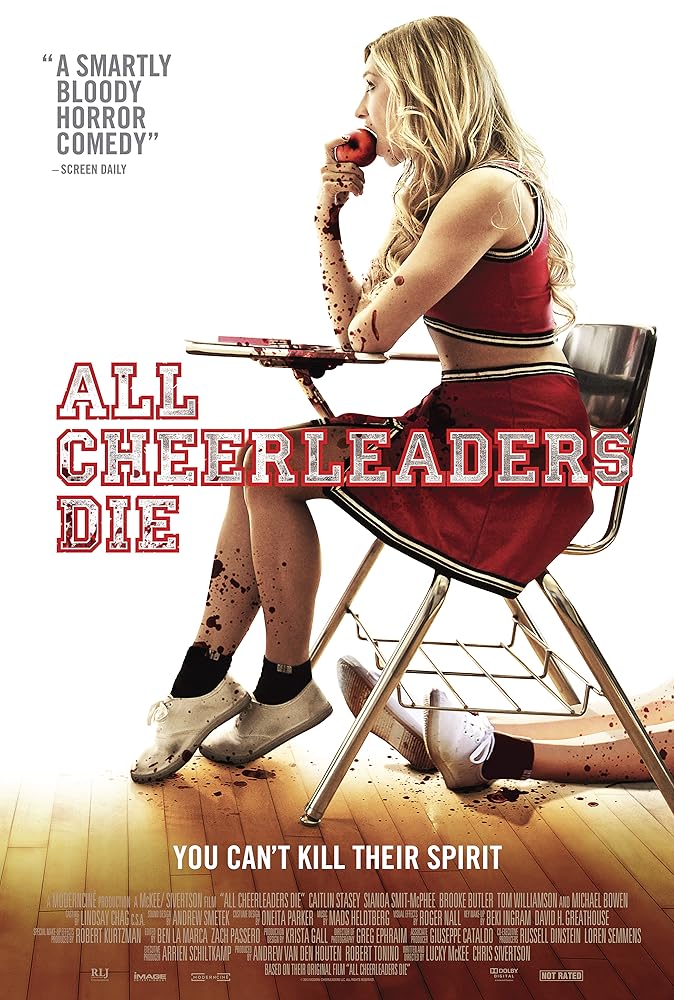
15 Second Review: All Cheerleaders Die

Based on the 2001 film of the same name All Cheerleaders Die feels like a throwback to millennial horror. Indeed, the plot is parts The Source (aka The Secret Craft, 2002), The Craft (1996) and Bring it On (2000). Overtones of Wicked Lake (2008, for which Chris Sivertson wrote the screenplay) do not do enough to bring the reimagining of All Cheerleaders Die into the current horror landscape. I am sure that co-writer/directors Silvertson and Lucky McKee have enormous fondness for the project given that the original All Cheerleaders Die was their debut film. However, the remake is easily McKee’s weakest film to-date (although his track-record is admittedly strong). All Cheerleaders Die aims for “WTF?” in a number of places, but the narrative drags in the middle. The final act picks up the pace, mainly because the script employs the “McKeeism” of establishing an abhorrent antagonist, then tipping the power-balance so far in their favour that there appears to be little hope for the protagonists. McKee uses the same trick in several movies (including The Woman and Red), but it is a powerful dramatic device, nevertheless. The closing moments sent me away with a smile but without cause to forget the weaknesses that plague the movie’s run-time.

Friday, 26 December 2014

15 Second Review: Death Wish 2

In the documentary Electric Boogaloo: The Wild, Untold Story of Cannon Films, several commentators have less than glowing things to say about Michael Winner. He is accused of including rape "just to get his rocks off" as well as being a "pathologically brutal, strange, sadistic, insecure, egotistical character". Death Wish 2 evinces the point, but not (only) because of its appalling sexual politics. Winner makes a habit of placing the camera behind objects: desks, plants, picture frames, anything to needlessly obscure the audience's view of the characters. Consequently, the camera lurks, voyeuristically spying on the events. I suspect the technique was meant to be unsettling, as if "someone is always watching, ready to pounce" (i.e. mug or take revenge on the populace). Instead, it feels more like the viewing position is that of a creepy little man who chuckles with glee while people are harmed. Death Wish 2's tone is thoroughly seedy as a result, thus corroborating Winner's reputation. Nevertheless, his strange directorial choice is certainly the most interesting aspect of a film that somehow manages to be dull and offensive simultaneously.Thus, Death Wish 2 laid the groundwork for Death Wish 3's onslaught of class and race-based intolerance. It also mysteriously concretized Bronson's standing as an action star, despite being entirely unsuited to and ill-equipped for the role. Perhaps Death Wish 2's real legacy is the acceptability of aging action stars in mainstream Hollywood today.  

Wednesday, 24 December 2014

15 Second Guest Review: Basic Instinct

According to Vice.com, during the trial of Luka Magnotta, prosecutor Louis Bouthillier tried to have Basic Instinct admitted into evidence (to be played in full for the jury) to support his theory that Magnotta took influence  from the film. Thankfully his request was denied, since it could have easily spun into a "media effects" argument (yawn). While rejecting the request, Judge Cournoyer gave an impromptu review of Basic Instinct: 

"to be plain, frank and honest, I fell asleep last night trying to watch it. This is not a movie which has withstood the test of time very nicely. It's such a bore."

Sunday, 21 December 2014

15 Second Review: See No Evil 2

Even in pre-production, this was a tough sell. See No Evil was so mediocre that it did not merit a sequel. Still, there was hope that the Soska Twins might bring some fun to the franchise. Moreover, a mediocre original means that there is no legacy to destroy, and no tedious origin story to set-up (the first film did not have much of a backstory, but it was still plenty). Unfortunately, See No Evil 2 barely rises above its predecessor. The plot is threadbare. That would not have mattered if the movie had delivered scares, but sadly the blood is as thin on the ground as the character development here. Limited-environment slashers only work if the deaths are creative and the killer is menacing. Here, the kills are disappointing and Kane fails to convince: he is massive, but he is not very threatening. Unsurprisingly veteran Danielle Harris is the highlight, although there are spots in which the directors could have pushed both Harris and Katharine Isabelle further: a few of the emotionally heightened sequences are a little flat, and both actors are capable of more. I am still waiting for the Soska sisters to deliver on the promise of Dead Hooker in a Trunk. See No Evil 2 just does not cut it, but I live in hope. One request: I want to see no See No Evil 3... unless Noboru Iguchi willing to direct, Then we are talking.

Wednesday, 10 December 2014

15 Second Review: The Hospital

In March 2014, a UK branch of the supermarket chain Tesco took it upon themselves to remove The Hospital from sale after receiving a customer complaint (see here). Surprisingly, the film - which the BBFC classified as only being suitable for viewers over the age of 18 - was 'too graphic and violent for a family store' according to the article linked above. Aside from anyone who a) read the DVD box, b) understands the certification system, or c) can read plainly printed consumer advice, who could have anticipated that The Hospital was not wholesome family fun? 
Flippancy aside, now that I have seen the film, I share the view that sales of The Hospital should be severely restricted. The content is "extreme"... as in extremely tedious. This life-draining atrocity ought to be restricted to bargain bins where it can remain hidden under the hundreds of other cheap horror films that one could spend time watching instead. The filmmakers have tried to tap into numerous trends in contemporary horror, but the resultant plot is a confused mess of found-footage motifs, supernatural events, torture porn elements, and hints of snuff. Imagine Death Tunnel with some offscreen rape, DeathTube with ghosts, or 7th Hunt featuring an Oliver Hardy impersonator who plays the role of "sex-criminal janitor". Now lower your expectations: rather than watching this unholy chimera, imagine that the plot is being vaguely relayed to you by an amnesiac who has Ben Stein's voice and Ed Milliband's charisma. That is how it feels trying to sit through The Hospital. The plot-based "rap" that accompanies the title sequence is easily the best part of the film, but only insofar as it is bad enough to be funny (unlike the rest of the movie). 
If any of this sounds appealing or remotely entertaining, it is not. Consider yourself warned. Given a choice between being admitted to a real hospital or enduring The Hospital again, I'd pick the former: it is a "no-brainer", just like the film itself.    

Wednesday, 3 December 2014

15 Second Review: The Babadook

The Babadook treads similar thematic ground to other motherhood horror films, including First Born, Baby Blues, and even We Need to Talk about Kevin. I class the latter as a horror film on the grounds that the content is patently horrific and dwells on emotional distress, even if it does not conform to the genre's usual tropes. The Babadook plays the opposite trick: We Need to Talk about Kevin is a horror film dressed up like a drama, whereas The Babadook is a drama dressed up as a horror film. Sadly, the filmmakers' commitment to that genre-base does the most damage to the movie: the third act plays out like a supercut of horror cliches, meaning the climax provides the film's least compelling moments. That slip perhaps suggests a lack of confidence on the director's or the production company's part. Either way, it tarnishes an otherwise bold (if not wholly original) movie. The "descent into madness" theme has been done to death in recent years, but this is a good example of how to prevent that madness from spiraling into narrative incoherence. I am not convinced that the eponymous spirit is destined to become a classic horror boogeyperson, but The Babadook is a solid effort on all fronts, boasting good effects, convincing performances (especially from the central pairing), and an atmospheric but unobtrusive score. In sum, this is a well paced, creepy little story that has enough thematic meat on its bones to satisfy most viewers. 

Tuesday, 2 December 2014

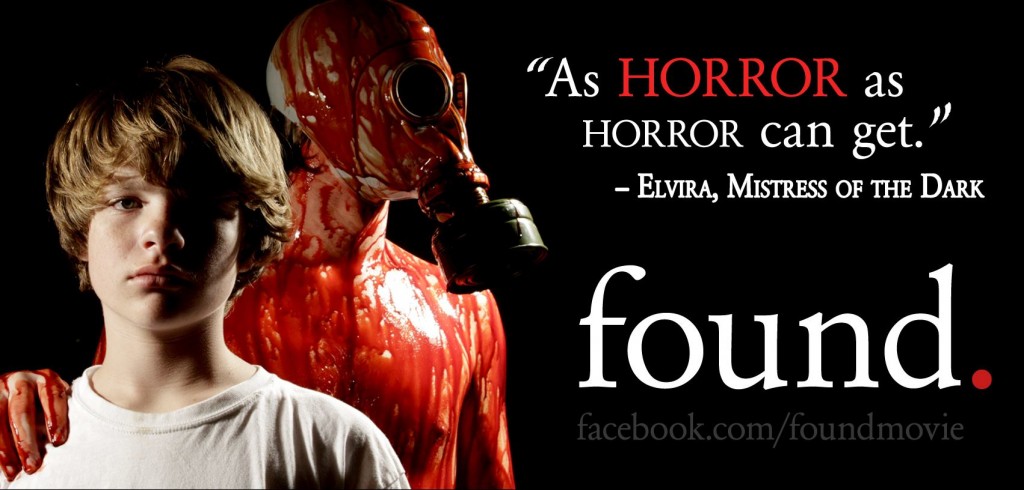
15 Second Review: Found

Found is a difficult film to write about, but not for the reasons the hype surround Found might suggest. Having been severely cut in Australia, Found has gained a reputation as being a "shocker". However, anyone who has seen A Serbian Film, let alone any other "extreme" horror films will probably consider Found to be really rather tame even in its unrated form (the pre-cut BBFC certified version excises the most controversial material, and so is even lighter). So why is the movie difficult to write about? Because it is so mediocre. The acting and effects are (for the most part) passable, but little more. The story is fine, but ultimately hollow. The filmmakers should have spent more time fleshing out the characters and the psychological drama, or amplifying the "shock" factor... or perhaps both. Unfortunately, Found is forgettable and so the aforementioned hype is likely to damage its reputation in the long-term.