Tuesday, 9 December 2014

CFP:Pornographies: Critical Positions

Edited Book: Pornographies: Critical Positions

DEADLINE FOR ABSTRACTS: 12 January 2015

Pornography has long been a controversial topic in the Social Sciences, Arts and Humanities, though recently scholars and activists from a variety of disciplinary and experiential backgrounds have begun to move beyond divisive ‘for and against’ arguments to focus closely on pornography’s many instantiations, its problems and potentials, and its relationships with established and new theoretical and methodological approaches. As such, the multiplicity of perspectives in the emerging interdisciplinary field of Porn Studies is rivalled only by the diversity, proliferation, mutability and mainstreaming of pornographies themselves. This edited, peer-reviewed volume will constitute a snapshot of current academic thought in relation to pornographies in order to reflect and put into dialogue the many innovative approaches that seek to understand porn cultures, histories, social relations and political economies.

We particularly welcome proposals for chapters from new voices in the study of pornography and envisage that these will sit alongside, challenge and complement work from more established writers in the field.

Topics may include but are not restricted to:

• Alternative pornographies

• Amateur pornographies

• Close reading of specific pornographic texts in relation to constructions of gender, ethnicity, sexuality and/or social class

• Consumption and/or production of pornographies

• Critical perspectives on gender, postfeminism and discourses of empowerment

• Disability, bodies and pornography

• LGBT pornographies and pornographic subcultures

• ‘Mummy porn’ (50 Shades of Grey, etc.) and literary pornographies

• Political pornographies

• Porn histories and genres

• ‘Pornification’ and the mainstreaming of pornography in mass culture

• Self-pornification via social media

• Sex-positive feminist perspectives on pornography and critiques of this

• ‘Dirty’ food marketing

• Fetishized porn and categories of ‘other’

• Sex workers and the porn industry

• Porn for women

The volume will be part of the University of Chester’s Issues in the Social Sciences (Series Editor: Katherine Harrison) and will be published by University of Chester Press (further information about the Press can be viewed here ; details of a recent publication in the series can be viewed here ). Finished chapters will be 6,500 words in length and written in accessible style for a diverse readership.


If you are interested in contributing a chapter to this volume please send an abstract of no more than 300 words and a short biographical note detailing institutional affiliation (where applicable) to both Katherine Harrison (k.harrison@chester.ac.uk) and Cassie Ogden (c.ogden@chester.ac.uk) by 12 January 2015.

Contributors will be informed of acceptance by 30 January 2015. Final drafts of chapters will be expected in April 2015 with publication scheduled for summer 2016. All contributions will be reviewed by the editors and, additionally, blind peer reviewed by an expert reader.

Dr Katherine Harrison
Senior Lecturer in Sociology
CBB119 Best Building
Department of Social and Political Science
University of Chester
Chester CH1 4BJ
Tel. +44 (0)1244512032

Email: k.harrison@chester.ac.uk

Series Editor: Issues in the Social Sciences 

Making Feminism Project Blog 

Sunday, 7 December 2014

Call for S.I., 2014, No. 2916 Annulment

A motion to annul Ed Vaizey's Audiovisual Media Services Regulations 2014 (S.I., 2014, No. 2916) - which pertains to the censorship and certification of online video and came into force on 1st December 2014 - has been put forward by Julian Huppert

Thursday, 4 December 2014

15 Second Review: A Bulldog for Christmas


A Bullshit for Christmas.

Petition: AMSR 2014

The new legislation against online porn rushed through parliament by the UK government bans depictions of female ejaculation: resultantly, many have called out this law as being fundamentally sexist. Other groups are concerned that the law is squarely aimed at the BDSM community. Both sets of complaints strike me as being entirely on point. Regardless of how one personally feels about any of the practices involved, if you are offended by the implications, consider signing this petition:

From Change.Org:

Remove Regulations for Video On Demand Pornography (AMSR 2014).

Sexist, archaic and damaging. This amendment to the communications act (2003) was rushed through parliament to take away the rights British people have on the internet.

Since 1/12/14, The Audiovisual Media Services Regulations 2014 requires that video-on-demand (VoD) online porn now adhere to the same guidelines laid out for DVD sex shop-type porn by the British Board of Film Censors (BBFC).

This includes the likes of: Spanking, Caning, Penetration by any object "associated with violence" , Physical or verbal abuse (regardless of if consensual), Watersports, Female ejaculation, Facesitting, Fisting.

The regulations make NO distinction between consensual and non-consensual acts.

They treat female ejaculation as a myth (and more unsafe/disgusting than male ejaculation).

This is one further attempt to censor the internet, as with David Cameron's plan to force ISPs to filter pornography.

They will damage smaller, independent film makers and producers, where as huge pornography companies will be left comparatively unscathed, causing a loss of British jobs as independent film makers are forced overseas.

Uneccesary censorship, patriarchal behaviour is all too often the path our government takes. We have 50 shades of grey out in the CINEMA in february, yet we're not allowed to watch a real equivalent made by British people. The government have no right to dictate what a responsible adult does for work, or what they look at on the internet.

We call for a complete removal of this amendment, underhandedly rushed through parliament in only ONE MONTH, which is inherently sexist, insulting and damaging to many British people.

Wednesday, 3 December 2014

15 Second Review: The Babadook

The Babadook treads similar thematic ground to other motherhood horror films, including First Born, Baby Blues, and even We Need to Talk about Kevin. I class the latter as a horror film on the grounds that the content is patently horrific and dwells on emotional distress, even if it does not conform to the genre's usual tropes. The Babadook plays the opposite trick: We Need to Talk about Kevin is a horror film dressed up like a drama, whereas The Babadook is a drama dressed up as a horror film. Sadly, the filmmakers' commitment to that genre-base does the most damage to the movie: the third act plays out like a supercut of horror cliches, meaning the climax provides the film's least compelling moments. That slip perhaps suggests a lack of confidence on the director's or the production company's part. Either way, it tarnishes an otherwise bold (if not wholly original) movie. The "descent into madness" theme has been done to death in recent years, but this is a good example of how to prevent that madness from spiraling into narrative incoherence. I am not convinced that the eponymous spirit is destined to become a classic horror boogeyperson, but The Babadook is a solid effort on all fronts, boasting good effects, convincing performances (especially from the central pairing), and an atmospheric but unobtrusive score. In sum, this is a well paced, creepy little story that has enough thematic meat on its bones to satisfy most viewers. 

Tuesday, 2 December 2014

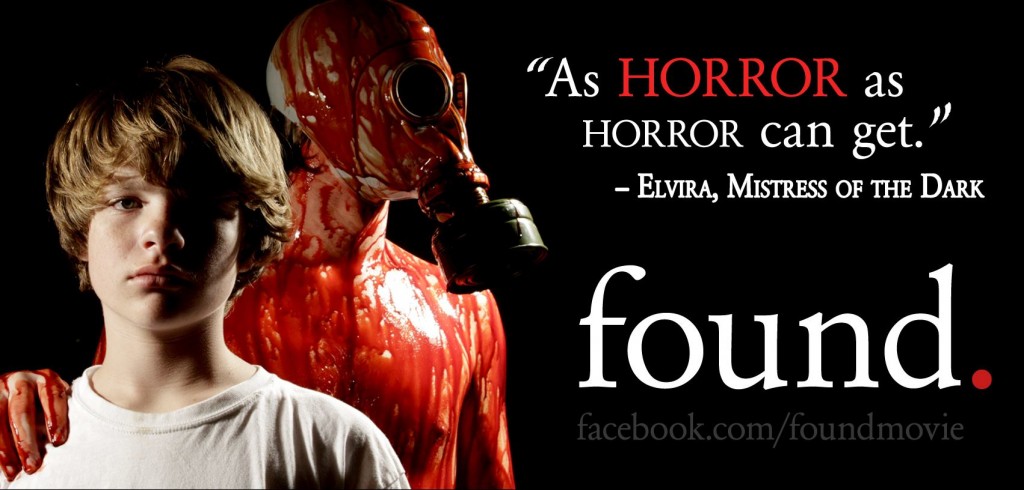
15 Second Review: Found

Found is a difficult film to write about, but not for the reasons the hype surround Found might suggest. Having been severely cut in Australia, Found has gained a reputation as being a "shocker". However, anyone who has seen A Serbian Film, let alone any other "extreme" horror films will probably consider Found to be really rather tame even in its unrated form (the pre-cut BBFC certified version excises the most controversial material, and so is even lighter). So why is the movie difficult to write about? Because it is so mediocre. The acting and effects are (for the most part) passable, but little more. The story is fine, but ultimately hollow. The filmmakers should have spent more time fleshing out the characters and the psychological drama, or amplifying the "shock" factor... or perhaps both. Unfortunately, Found is forgettable and so the aforementioned hype is likely to damage its reputation in the long-term. 

Monday, 1 December 2014

15 Second Review: Repeaters

Since it is a time-loop narrative, I was predisposed to like Repeaters. Bias aside, the film is nevertheless one of the smarter efforts in that micro-genre; it much stronger than its tepid reviews suggest [pro-tip: if anyone mentions Groundhog Day in a review for a time-loop film - as reviewers (ironically) seem to ad infinitum - stop reading... umm, except in this case]. Most explicitly, Repeaters is based on a moral thought-experiment: as the tagline has it 'what would you do' if there were no consequences for your actions? The three protagonists explore different answers to that question, resulting in degrees of self-destruction, (attempts) to forgive others, and outright criminality. These responses are augmented by a combination of the time-loop structure and the diegetic context; this imbricated thematic core is Repeaters' secret weapon. The opening depicts the three protagonists conversing about their damaged relationships in a rehab therapy session. Thus, the film grounds its moral thought-experiment in concerns regarding a) the damage drug-fueled hedonism has on one's social ties - which is paralleled by their initial reactions to the time-loop - b) cycles of addiction, including the propensity to downplay consequences in favor of short-term fulfillment and descent into unsatisfying compulsion in the long-term, and c) the cyclic nature of therapy, which provides a rigid structure that forces individuals to dwell on their actions: the goal is to affect change, but therapy can feel closer to stasis because it necessitates revisiting the past. These latter themes are astutely captured by the loop-framework. This rich, multilayered approach to form and theme results in a film that far transcends its modest budget.