
Showing posts with label Slasher. Show all posts
Showing posts with label Slasher. Show all posts
Monday, 27 May 2024

Friday, 9 February 2024
Video Shop Horrors Exhibition

"Video Shop Horrors" was a multimedia exhibition held at Northumbria University's Gallery North, 26th October to 11th November 2023.
"Video Shop Horrors" captured the nascent video shop experience. In the 1980s, horror videos always seemed to be more effectively promoted than those of other genres. The artwork tended to be bombastic, awash with contorted faces, flashing blades, ghouls and gore.
The so-called ‘video nasties’ moral panic came and went, but its legacy, the types of film it encompassed, and the promotional strategies of the first video distribution companies, live on. This exhibition captured the dynamism of this hugely significant technological moment, pooling from original archival materials, to showcase the promotional strategies employed by video companies to attract consumers and, in some cases, to whip up controversy. The significance of video to the development and enduring popularity of horror films cannot be understated.
"Video Shop Horrors" recreated the 1980s/90s video shop experience whilst celebrating the aesthetic and the wealth of films that helped define and redefine the horror film genre.
The "Video Shop Horrors" exhibition was led by Dr Johnny Walker drawing on his extensive archive of video-related paraphernalia. The exhibition featured video and music by Dr Steve Jones. The exhibition represents the interests of staff working within the University’s new Horror Studies Research Group.
Below are some videos documenting the exhibition:
An interview with me and Johnny about the exhibition:
The soundtrack I composed for the exhibition:
The Metamodern Slasher Film - New Book Out Now!

My new book, The Metamodern Slasher Film is finally out!
To find out more, click here: Metamodern Slasher Film | Dr Steve Jones
If you order through Edinburgh University Press, use the code NEW30 to get 30% off
Here is a video presentation about the book's content: https://www.youtube.com/watch?v=y9L3Fn6U0P4
Thursday, 27 April 2023
Talk and interviews at Kurja Polt Film Festival
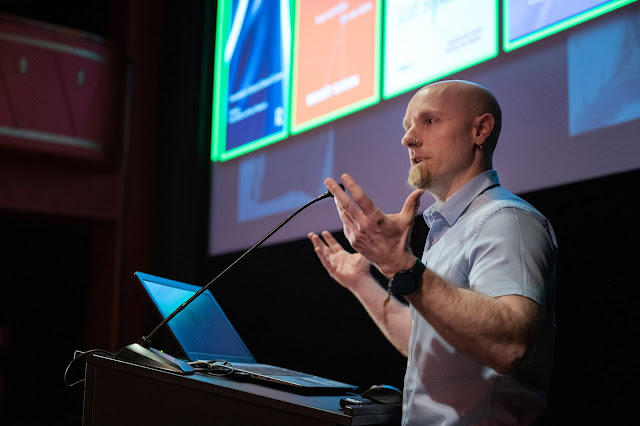
I recently attended Kurja Polt Film festival (Slovenia) to give a talk based on my forthcoming book The Metamodern Slasher Film (which should hopefully be out with Edinburgh University Press later this year).
My talk was titled "Subtraction and Compression in Contemporary Indie Horror" (or, as Google translate put it, "Countdown and The Thickening"). The abstract is available here. A recording of the talk is available below
While I was there, I was interviewed for RTV's Osmi Dan and for the radio programme Gremo v Kino. I was also interviewed by Ana Jurc for MMC about my broader research profile.

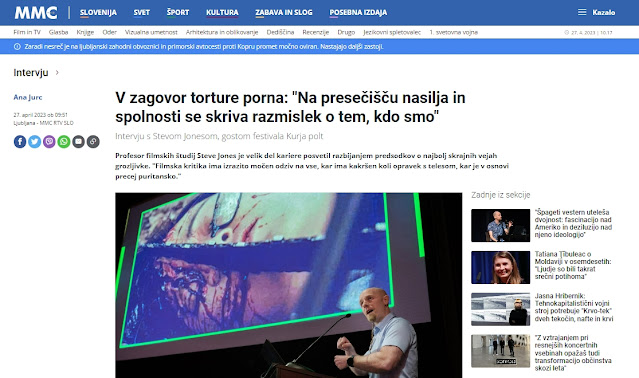
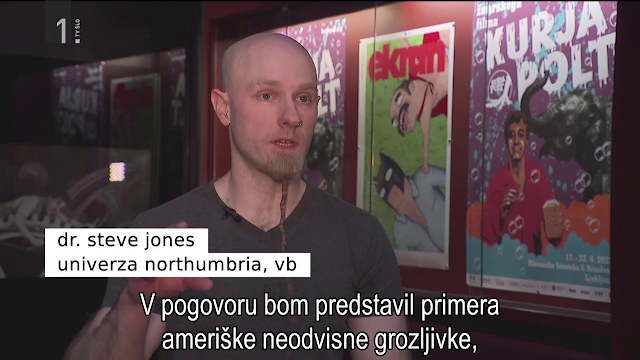
It was fantastic to be back in Ljubljana, to be speaking alongside Alexia Kannas again, and to meet the other guests at this year's festival
Friday, 1 April 2022
Metamodern Slashers - Video and Article

Two updates to my ongoing research project on Metamodern Slasher films:
First, the video of my keynote at last year's Slasher Studies conference has been uploaded to YouTube: it is available here https://www.youtube.com/watch?v=bJZ8bjphP_A
Second, the first article from the project has just been published in Slovenian language in Kino. Here is a link to the abstract: https://e-kino.si/clanki/od-postmodernega-k-metamodernemu-slasherju/
Friday, 8 October 2021
New Chapter on the Elm Street Series

Here is the abstract:
Long-running horror series are reputed to yield diminishing returns (both in terms of profit and quality). At first glance, the A Nightmare on Elm Street series appears to fit that established pattern. For instance, lead antagonist Freddy supposedly ‘deteriorates’ from sinister, backlit child molester to comic-book ‘Las Vegas lounge’ stand-up act by the end of the 1980s (Schoell and Spencer 1992, 116). However, interviews from the period indicate that comedy was a central component from the outset of the series; it is not, as has been often suggested, that the series’ horror was diluted by the introduction of humour in later sequels. Such misremembrances are entrenched by the writers’, directors’ and actors’ retrospective reflections on Elm Street, which colour how the series is understood more broadly.
This chapter will focus on one of the most common misremembrances embedded into Elm Street’s lore; that the series began with hard rules about the relationship between dream and reality, which became looser (to the point of incoherence) as the series progressed. As close textual analysis and examination of archival interviews will demonstrate, the series’ “rules” were never as clearly established as creator Wes Craven intended. Moreover, rather than complaining that the continuing story did not hold together—indeed, Craven dismissed parts 2-6 of the series on these grounds—I argue that the series ought to be taken on its own terms. The individual films may vary in aesthetic and quality for various industrial reasons, but they are nevertheless chapters in a continuing narrative, and ought to be understood as such. Given that the diegesis is based on shared experiences—secrets held by Springwood’s parents, nightmares and abilities shared by the teens—it is reductive to understand the Elm Street films as anything other than an imbricated whole. As such, this chapter will demonstrate that the series’ narrative is best understood as a recurring nightmare. Its logic is dreamlike, being constituted by events, characters and motifs that are echoed across the series. Thus, this chapter contends that to dismiss the Elm Street sequels as a product of diminishing returns is to overlook the series’ narrative richness. More broadly, this chapter makes a case for understanding sequels as valuable parts of a whole, rather than dismissing them as inferior copies of the original.
If you would like to read it, it is available here
The collection is available here. It features many excellent chapters on horror, including one by my colleague Kate Egan. Northumbria Uni's horror research is being represented in back-to-back chapters in this collection!
Wednesday, 25 August 2021
Slasher Studies Conference Keynote and Roundtable
I recently had the pleasure of delivering a Keynote talk about my current book project - The Metamodern Slasher Film - at the Slasher Studies Summer Camp conference (on Friday the 13th August, no less!)
Here is a recording of the keynote:
I also participated in a roundtable discussion about Slasher Studies alongside Wickham Clayton, Joan Hawkins and Murray Leeder. Here is a link to that discussion:
My thanks to the organisers - Wickham Clayton and Daniel Sheppard - for inviting me to contribute to this event
Thursday, 10 June 2021
The Metamodern Slasher Film [video]
My talk on the Metamodern Slasher for Kurja Polt Festival is now live:
The paper is based on my forthcoming book about the Metamodern Slasher film
The virtual other talks are available here:
Dr Shellie Mcmurdo and Dr Laura Mee - "Ghosts in the (VCR) Machine: Video, the Horror Genre, and Dead Media"
Dr Alexia Kannas - "The Dead Can Dance: Cinematic Ghosts of Post-Punk Melbourne"
The final paper will be available tomorrow:
Dr Johnny Walker - "Activist Horror Film: The Genre as Tool for Change"
Monday, 17 May 2021
Keynote Talk: The Metamodern Slasher


On Friday 13th august, I'll be delivering a keynote talk (alongside Prof Vera Dika) at the Slasher Studies Summer Camp conference
Here is my abstract:
It is commonly proposed that since the mid-00s, the slasher has predominantly followed a trend for remaking and rebooting established properties. While there certainly have been many remakes of classic slasher properties, a significant body of original slasher films have also been made in the era. This talk will focus on one of the most distinctive trends in the subgenre since the mid-00s: the metamodern slasher film.
A comparison with the Scream-era postmodern slasher will help to explain what distinguishes the metamodern slasher from its immediate predecessors. Postmodern slasher films tend to be cynical, flippant or even nihilistic in tone. Postmodern slasher films are usually ludic, goading viewers into guessing the killer’s identity but then wrongfooting the audience with restricted or unreliable epistemic access to the narrative events. These films also commonly suggest that subgenre conventions are immutable, and that originality is no longer possible.
The metamodern slasher is distinguished from the postmodern slasher in several ways. First, the metamodern sensibility is characterised by its sincere tone. Second, although these films are playful, they react against the postmodern slasher’s duplicity. Instead of foregrounding epistemic restrictions, the value of individual characters’ idiosyncratic, subjective experiences is emphasised. Third, the metamodern slasher is characterised by a desire to innovate within the subgenre, underpinned by the assumption that originality is still possible. This talk will draw on a variety of contemporary examples to demonstrate how the metamodern slasher film operates, and why it constitutes a significant development within the subgenre.
Subscribe to:
Posts (Atom)