
Monday, 27 May 2024

Friday, 9 February 2024
Video Shop Horrors Exhibition

"Video Shop Horrors" was a multimedia exhibition held at Northumbria University's Gallery North, 26th October to 11th November 2023.
"Video Shop Horrors" captured the nascent video shop experience. In the 1980s, horror videos always seemed to be more effectively promoted than those of other genres. The artwork tended to be bombastic, awash with contorted faces, flashing blades, ghouls and gore.
The so-called ‘video nasties’ moral panic came and went, but its legacy, the types of film it encompassed, and the promotional strategies of the first video distribution companies, live on. This exhibition captured the dynamism of this hugely significant technological moment, pooling from original archival materials, to showcase the promotional strategies employed by video companies to attract consumers and, in some cases, to whip up controversy. The significance of video to the development and enduring popularity of horror films cannot be understated.
"Video Shop Horrors" recreated the 1980s/90s video shop experience whilst celebrating the aesthetic and the wealth of films that helped define and redefine the horror film genre.
The "Video Shop Horrors" exhibition was led by Dr Johnny Walker drawing on his extensive archive of video-related paraphernalia. The exhibition featured video and music by Dr Steve Jones. The exhibition represents the interests of staff working within the University’s new Horror Studies Research Group.
Below are some videos documenting the exhibition:
An interview with me and Johnny about the exhibition:
The soundtrack I composed for the exhibition:
Horror Studies Research Group at Northumbria

We've been busy since we launched in October 2023. Aside from running our reading group, I set up our website, Twitter/X feed, and YouTube channel. The YouTube channel features playlists of various talks, podcasts and events our members have been involved in.
We organised a multimedia exhibition - "Video Shop Horrors" - at Northumbria University's Gallery North, 26th October to 11th November 2023. Read more about that here.
We hosted a workshop for the AHRC funded Youth and Horror Network, organised by Kate Egan (Northumbria Univeristy) and Cat Lester (Birmingham University) on 7th November.
We also won funding to host our annual Horror Studies Now conference: more details and the Call for Papers is available here.
There are lots of developments to follow, but if you want to get in touch, contact us at horrorstudies@northumbria.ac.uk
The Metamodern Slasher Film - New Book Out Now!

My new book, The Metamodern Slasher Film is finally out!
To find out more, click here: Metamodern Slasher Film | Dr Steve Jones
If you order through Edinburgh University Press, use the code NEW30 to get 30% off
Here is a video presentation about the book's content: https://www.youtube.com/watch?v=y9L3Fn6U0P4
Thursday, 27 April 2023
Talk and interviews at Kurja Polt Film Festival

I recently attended Kurja Polt Film festival (Slovenia) to give a talk based on my forthcoming book The Metamodern Slasher Film (which should hopefully be out with Edinburgh University Press later this year).
My talk was titled "Subtraction and Compression in Contemporary Indie Horror" (or, as Google translate put it, "Countdown and The Thickening"). The abstract is available here. A recording of the talk is available below
While I was there, I was interviewed for RTV's Osmi Dan and for the radio programme Gremo v Kino. I was also interviewed by Ana Jurc for MMC about my broader research profile.

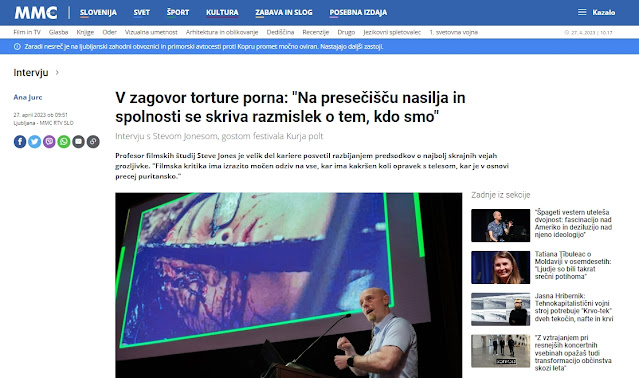
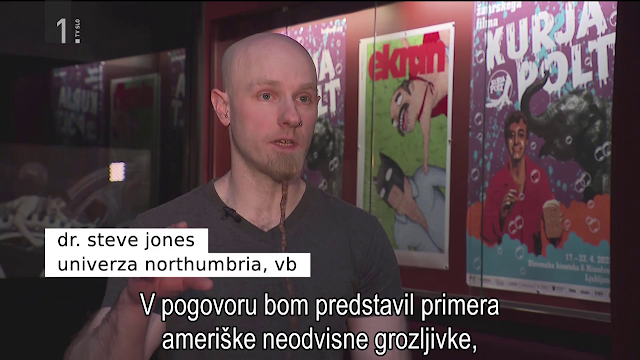
It was fantastic to be back in Ljubljana, to be speaking alongside Alexia Kannas again, and to meet the other guests at this year's festival
Friday, 1 April 2022
Metamodern Slashers - Video and Article

Two updates to my ongoing research project on Metamodern Slasher films:
First, the video of my keynote at last year's Slasher Studies conference has been uploaded to YouTube: it is available here https://www.youtube.com/watch?v=bJZ8bjphP_A
Second, the first article from the project has just been published in Slovenian language in Kino. Here is a link to the abstract: https://e-kino.si/clanki/od-postmodernega-k-metamodernemu-slasherju/
Wednesday, 2 March 2022
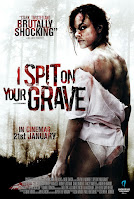
New Article on Revenge and I Spit on Your Grave (2010)
Abstract
Despite being a prevalent theme in popular cinema, revenge has received little dedicated attention within film studies. The majority of research concerning the concept of revenge is located within moral philosophy, but that body of literature has been overlooked by film studies scholars. Philosophers routinely draw on filmic examples to illustrate their discussions of revenge, but those interpretations are commonly hindered by their authors’ inexperience with film studies’ analytical methods. This article seeks to bridge those gaps. The 2010 remake of I Spit on Your Grave is used as a case study to illustrate the benefits of an interdisciplinary engagement with revenge. Philosophical literature on the topic has routinely posited that revenge is either appealing or appalling, and that impasse has stifled conceptual understanding. The interdisciplinary approach employed here elucidates that revenge is simultaneously appealing and appalling; this dualistic nature is evident in I Spit on Your Grave since it is built into the narrative design. I conclude that an interdisciplinary approach to revenge has the potential to advance understanding of revenge-qua-concept both within films studies and philosophy.
Friday, 8 October 2021
New Chapter on the Elm Street Series

Here is the abstract:
Long-running horror series are reputed to yield diminishing returns (both in terms of profit and quality). At first glance, the A Nightmare on Elm Street series appears to fit that established pattern. For instance, lead antagonist Freddy supposedly ‘deteriorates’ from sinister, backlit child molester to comic-book ‘Las Vegas lounge’ stand-up act by the end of the 1980s (Schoell and Spencer 1992, 116). However, interviews from the period indicate that comedy was a central component from the outset of the series; it is not, as has been often suggested, that the series’ horror was diluted by the introduction of humour in later sequels. Such misremembrances are entrenched by the writers’, directors’ and actors’ retrospective reflections on Elm Street, which colour how the series is understood more broadly.
This chapter will focus on one of the most common misremembrances embedded into Elm Street’s lore; that the series began with hard rules about the relationship between dream and reality, which became looser (to the point of incoherence) as the series progressed. As close textual analysis and examination of archival interviews will demonstrate, the series’ “rules” were never as clearly established as creator Wes Craven intended. Moreover, rather than complaining that the continuing story did not hold together—indeed, Craven dismissed parts 2-6 of the series on these grounds—I argue that the series ought to be taken on its own terms. The individual films may vary in aesthetic and quality for various industrial reasons, but they are nevertheless chapters in a continuing narrative, and ought to be understood as such. Given that the diegesis is based on shared experiences—secrets held by Springwood’s parents, nightmares and abilities shared by the teens—it is reductive to understand the Elm Street films as anything other than an imbricated whole. As such, this chapter will demonstrate that the series’ narrative is best understood as a recurring nightmare. Its logic is dreamlike, being constituted by events, characters and motifs that are echoed across the series. Thus, this chapter contends that to dismiss the Elm Street sequels as a product of diminishing returns is to overlook the series’ narrative richness. More broadly, this chapter makes a case for understanding sequels as valuable parts of a whole, rather than dismissing them as inferior copies of the original.
If you would like to read it, it is available here
The collection is available here. It features many excellent chapters on horror, including one by my colleague Kate Egan. Northumbria Uni's horror research is being represented in back-to-back chapters in this collection!
Wednesday, 25 August 2021
New Publication: Evil Seeds - The Ultimate Movie Guide to Villainous Children
The collection Evil Seeds - The Ultimate Movie Guide to Villainous Children (edited by Vanessa Morgan) is out now

https://www.amazon.com/Evil-Seeds-Ultimate-Villainous-Children/dp/B09CRM3KKN
I contributed sections on Plac Zabaw/Playground (2016) and Ils/Them (2006)...
...although I wrote them before becoming a father (not as a reaction to my daughter's arrival) 😂
Slasher Studies Conference Keynote and Roundtable
I recently had the pleasure of delivering a Keynote talk about my current book project - The Metamodern Slasher Film - at the Slasher Studies Summer Camp conference (on Friday the 13th August, no less!)
Here is a recording of the keynote:
I also participated in a roundtable discussion about Slasher Studies alongside Wickham Clayton, Joan Hawkins and Murray Leeder. Here is a link to that discussion:
My thanks to the organisers - Wickham Clayton and Daniel Sheppard - for inviting me to contribute to this event
Thursday, 10 June 2021
The Metamodern Slasher Film [video]
My talk on the Metamodern Slasher for Kurja Polt Festival is now live:
The paper is based on my forthcoming book about the Metamodern Slasher film
The virtual other talks are available here:
Dr Shellie Mcmurdo and Dr Laura Mee - "Ghosts in the (VCR) Machine: Video, the Horror Genre, and Dead Media"
Dr Alexia Kannas - "The Dead Can Dance: Cinematic Ghosts of Post-Punk Melbourne"
The final paper will be available tomorrow:
Dr Johnny Walker - "Activist Horror Film: The Genre as Tool for Change"
Monday, 17 May 2021
Keynote Talk: The Metamodern Slasher


On Friday 13th august, I'll be delivering a keynote talk (alongside Prof Vera Dika) at the Slasher Studies Summer Camp conference
Here is my abstract:
It is commonly proposed that since the mid-00s, the slasher has predominantly followed a trend for remaking and rebooting established properties. While there certainly have been many remakes of classic slasher properties, a significant body of original slasher films have also been made in the era. This talk will focus on one of the most distinctive trends in the subgenre since the mid-00s: the metamodern slasher film.
A comparison with the Scream-era postmodern slasher will help to explain what distinguishes the metamodern slasher from its immediate predecessors. Postmodern slasher films tend to be cynical, flippant or even nihilistic in tone. Postmodern slasher films are usually ludic, goading viewers into guessing the killer’s identity but then wrongfooting the audience with restricted or unreliable epistemic access to the narrative events. These films also commonly suggest that subgenre conventions are immutable, and that originality is no longer possible.
The metamodern slasher is distinguished from the postmodern slasher in several ways. First, the metamodern sensibility is characterised by its sincere tone. Second, although these films are playful, they react against the postmodern slasher’s duplicity. Instead of foregrounding epistemic restrictions, the value of individual characters’ idiosyncratic, subjective experiences is emphasised. Third, the metamodern slasher is characterised by a desire to innovate within the subgenre, underpinned by the assumption that originality is still possible. This talk will draw on a variety of contemporary examples to demonstrate how the metamodern slasher film operates, and why it constitutes a significant development within the subgenre.
Thursday, 28 January 2021
New Chapter Out Now
I have a chapter in the edited collection New Blood: Critical Approaches to Contemporary Horror. My chapter is titled "Hardcore Horror: Challenging the Discourses of Extremity".
Abstract:
This chapter explores the relationship between ‘hardcore’ horror films, and the discursive context in which mainstream horror releases are being dubbed ‘extreme’. This chapter compares ‘mainstream’ and ‘hardcore’ horror with the aim of investigating what ‘extremity’ means. I will begin by outlining what ‘hardcore’ horror is, and how it differs from mainstream horror (both in terms of content and distribution). I will then dissect what ‘extremity’ means in this context, delineating problems with established critical discourses about ‘extreme’ horror. Print press reviewers focus on theatrically released horror films, ignoring microbudget direct-to-video horror. As such, their adjudications about ‘extremity’ in horror begin from a limited base that misrepresents the genre. Moreover, ‘extremity’ is not a universally shared value, yet it is predominantly presented as if referring to an objective, universally agreed-upon standard. Such judgements change over time. Moreover, in contrast to marketers’ uses of ‘extreme’, press critics predominantly use the term as a pejorative. Although academics have sought to defend and contextualise particular maligned films and directors, scholars have focused on a handful of infamous examples. As I will explain, academic publishers implicitly support that narrow focus. As such, the cumulative body of scholarly work on ‘extreme’ horror inadvertently replicates print press critics’ mischaracterisation of the genre. These discursive factors limit our collective understandings of ‘horror’, its ostensible ‘extremity’. and of ‘extremity’ qua concept. Given that the discourse of ‘extremity’ is so commonly employed when censuring representations that challenge established genre conventions, it is imperative that horror studies academics attend to peripheral hardcore horror texts, and seek to develop more robust conceptual understandings of extremity.
The editors - Eddie Falvey, Joe Hickinbottom and Jon Wroot - hosted a book launch event featuring some of the contributors (including me). The video of that event is available here: https://youtu.be/8HACL-xhdTM

Friday, 11 December 2020
Article on Slasher films in Slovenian

Way back in April, my article on slasher films was published in Kino
Here is a link to the abstract (in Slovenian): https://e-kino.si/articles/done-to-death-the-slasher-cycle/
The article was based on papers I presented at Abertoir (2018) and Kurja Polt (2019). That work is the foundation for a book I'm currently writing on the metamodern slasher film.
Tuesday, 22 September 2020

Monday, 1 June 2020
Snuff Interview
I was recently interviewed by Zafer Yilmaz (Hacettepe University) about the snuff phenomenon. The interview is published here on the SineBlog in Turkish
Below is a translation into English:
Films shot for entertainment and profit that show real murders and rapes, are referred to as “Snuff” movies. Do Snuff films really exist?
As far as documented cases are concerned, no. Reportedly, the FBI’s criminal investigations into snuff have not uncovered any such material. The principal criterion for defining snuff is that the footage should contain (usually, culminate in) murder. The term ‘snuff’ conveys that a life has been extinguished (“snuffed out”). The hypothetical footage might include other types of violence – such as sexual violence, torture, and so forth – but these other acts are not in themselves sufficient for a film to be classified as snuff. Also, as you note, the motivations matter: snuff is filmed murder for the sake of entertainment and profit.
Note the term “murder” here: the footage has to be of an intentionally caused human death. To illustrate: a film such as Cannibal Holocaust (1980) was shot with the intention of generating profit and was meant to entertain an audience. The film includes real animal deaths, which were staged specifically for the film. For instance, the cast kill and eat a large turtle. The turtle’s death would not have occurred otherwise. However, killing an animal is not classed as murder, and therefore such footage is not snuff.
Many fictional, staged films seek to emulate what snuff might look like, and that sustains the myth that there are real snuff movies. I call these fictional emulations ‘faux-snuff’ films. Usually, vérité techniques (natural light, ambient sound, handheld camera and so forth) are employed to suggest that the footage has been captured by amateurs rather than professional filmmakers. That branch of snuff was almost certainly influenced by uses of vérité techniques in cinema more broadly (and perhaps in Cannibal Holocaust specifically), and by mondo films. Mondo films are documentaries that detail (and sometimes stage) events that would not normally be recorded on film. One famous relevant example is Faces of Death (1978), which contains authentic footage of animal deaths, genuine images of dead humans (taken, for instance, from news footage), and staged emulations of human deaths. The compilation of elements is presented as a documentary, and the vérité approach is employed where human deaths are fabricated, to pass off the footage as “real”. Furthermore, faux-snuff is likely influenced by the film Snuff (1976), which reputedly contained a real murder, which was clearly staged: multiple camera set-ups are employed, and the footage is obviously edited according to traditional conventions to establish continuity. In veering towards a vérité style, faux-snuff filmmakers seek to avoid those overt tell-tale signs that the footage has been intentionally constructed.
Some filmmakers use additional techniques for added realism, or to blur the lines between fiction and “fact”. In Shane Ryan’s Amateur Porn Star Killer series (2007-2009), genitally explicit images of sex are included alongside the staged murder. Since we can see that the sex unambiguously really happened, it is implied that the ostensible murder also could have occurred. Elsewhere, Fred Vogel’s August Underground’s Mordum (2003) includes footage of one performer cutting herself and self-inducing vomiting. Again, since these acts are genuine, it is implied that the staged FX-based murders are also “real”.
Two Serbian films released around 2010s (The Life and Death of a Porno Gang and A Serbian Film) raise the subject of snuff. Are snuff rumours commonly found in other geographical contexts?
Snuff appears in a wide variety of cultural contexts. Many faux-snuff films or films about the snuff myth are American. Obviously, there is Snuff (1976), but also Hardcore (1979), Run if You Can (1988), 8mm (1999) and so forth. Some of the more recent entries such as The Great American Snuff Film (2004), The Poughkeepsie Tapes (2007), and The Cohasset Snuff Film (2012) put America or American place names in the titles. Cumulatively, it feels as if these American filmmakers are laying claim to the mythology in some way.
Some of those American films are set in other countries. Famously, Snuff was marketed as being filmed in “South America, where life is cheap”. Other films follow suit: King of the Kickboxers (1990) features a New Yorker traveling to Thailand to expose a snuff ring, Live Feed (2006) features American tourists encountering snuff production in China, and so on. These films have been accused of xenophobia or orientalism because they depict Americans encountering abhorrent “exotic” behaviours in “foreign” lands. Other countries have reflected that relationship too: perhaps in response to Snuff’s depiction of South America, Reel Savages (1977) depicts a Brazilian snuff filmmaker who feigns being North American, for instance. The Italian film Emanuelle in America (1977) also presents an American journalist encountering a snuff film production in an undisclosed location (implied to be outside the US, given that it is accessed by private jet).
There are numerous other examples of European snuff-themed films, including the Spanish film Tesis (1996), the Belgian film C'est Arrivé Près de Chez Vou (1992), the Italian film Snuff Trap (2003), as well as the British films The Last Horror Movie (2003) or the “Sick Room” segment of Cradle of Fear (2001), and the Irish film Red Room (2017). Japan has also produced its share of faux-snuff and snuff-themed films, perhaps most famously the early entries in the Guinea Pig series (1985), but also Abnormal: Ingyaku (1988), and Muzan-e (1999).
What I'm suggesting is that the snuff theme is an international phenomenon. These films probably play differently when contextualised against these various cultural backgrounds. I could not speak to that with any authority. In the UK, the spectre of snuff is still tinged by the video nasties panic and the connotations of “media effects” associated with that controversy. The idea that films – especially unregulated films, distributed in clandestine ways and consumed in private – are somehow intimately linked with real-world violence remains baked into British horror film culture. Those connotations have almost certainly helped to shape and sustain the snuff myth in the UK.
In your work, you refer to the film Snuff (1976) as a key moment in the development of pseudo-Snuff films and in anti-pornography feminists' responses to the phenomenon. What is the relationship between Snuff-myth and pornography?
Famously, protests were staged outside screenings of Snuff, based on its alleged depiction of a man actually killing a woman (which, to be clear, was faked). Whether those protests were authentic feminist protests, whether they were staged as part of the film’s publicity campaign, or whether it was a combination of both varies according to which sources one consults. In any case, Snuff garnered attention from feminist campaign groups such as WAVAW (Women Against Violence Against Women). The attention to Snuff was amplified by the staged killing happening on a bed, and its initial presentation as a sexual scenario. Snuff played into concerns various feminist groups were raising about pornography at the time. Broadly speaking, such campaigners suggested (to various degrees) that even mainstream hardcore pornography regularly and overtly depicts sexual violence, that women are commonly harmed when making pornography, that pornography encourages sexually sadistic attitudes among its viewers, and that porn goads viewers into committing violence and sexual violence in the real world. Snuff is an extension of these ideas: in this view, men routinely gain sexual pleasure by consuming images of women being harmed, so it is only a slight amplification of that paradigm to suggest that men would gain sexual pleasure from seeing a woman killed on camera. At the root of this model is the idea that porn is misogynistic, and that porn consumers are principally aroused by seeing women being harmed or degraded. Remember that in this view, such forms of porn are thought to be readily available and mainstream, so these attitudes are presented as if they are normative.
In the writings of anti-porn feminists such as Catharine MacKinnon, Gloria Steinem, and Jane Caputi, snuff is frequently presented as a type of pornography. That way of presenting snuff is replicated in popular culture too. Even in its title, Hardcore (1979) represents snuff films as a branch or extension of hardcore porn. Since snuff is only a myth, it isn’t possible to pin down a typical snuff consumer or to pinpoint the average mode of snuff consumption. Instead, a more familiar model (porn production and consumption) is employed as a substitute.
That slippage is further naturalised by porn’s associations with illicitness and taboo content. One would imagine that if a murder were staged purely for a commercial film, the footage would be banned from distribution, not only because it is evidence of a crime, but also because it is offensive. The extant framework for expressing how improper it would be to distribute such footage is to dub it “obscene”. Obscenity laws usually focus on sexual depictions, because presenting the “private” act of sex in explicit detail is broadly considered to be improper. So, the association between snuff and porn also possibly expresses an attempt to articulate what precisely is objectionable about snuff. A murder entailed during the creation of a hypothetical snuff movie would obviously be objectionable, but I would assume many would not be satisfied if such a murder were prosecuted without reference to the filming and intent to commercially distribute the footage – the latter is an additional wrong, and “obscenity” helps to pin down that wrong according to a familiar legal model.
What do you think are the socio-psychological and cultural foundations that prepare people to believe in Snuff-myth? How instructive do you think the media-effects model can be in this regard?
People are probably prepared to believe in the existence of snuff because it is within the realms of possibility. Filming a murder then distributing the footage is a remarkably unwise activity (most murderers would seek to remove evidence of their crime rather than reproducing it). Nevertheless, people engage in other serious crimes for financial gain, so it is conceivable that someone might become involved in snuff production if the promise of financial reward were significant enough.
Even if most people would not want to see authentic footage of a murder themselves, one might also readily imagine that someone might want to. It seems at least conceivable that a niche audience might watch snuff (if it existed), based on morbid curiosity about murder. That morbid curiosity might initially seem alien because murder is so horrific, but a cultural fascination with the idea of homicide is quite widespread. Certainly, many people might find crime fiction appealing because they enjoy imagining murderers being brought to justice. There is undoubtedly comfort or satisfaction in the re-enforcement of moral norms. However, the prevalence of crime fiction centred on murder and murderers also suggests that people might be curious about killing and the kind of people who are capable of taking another’s life. That curiosity is probably fuelled by most people believing that they are incapable of such action (outside of self-defence) or are unable to seriously conceive of themselves committing homicide. Crime fiction offers a safe way into exploring those ideas without the moral baggage of engaging with a real murder or murderer, and divorced from the reality of a victim’s grieving loved ones. Documentaries and true crime books also garner large audiences who are interested in actual murder cases, and those texts seem more directly invested in unpicking what drives killers to homicide. Again, part of the appeal might stem from the reinforcement of moral boundaries (marking differences between the killer and the viewer). In any case, however abhorrent murder is, it evidently fascinates many people, for a multitude of reasons.
Faux-snuff or snuff-themed fiction offer alternative windows into the horrors of murder. The vérité aesthetic might imply immediacy, but I assume viewers a priori understand that they are engaging with fiction. I'm sure most viewers would turn away from a faux-snuff film if they ultimately believed it to contain genuine murder. Knowing that it is only fiction, faux-snuff viewers might find vicarious thrills from being close to the killer (seeing what the murderer sees), but others almost certainly focus on the victim’s position, and others on the kind of person who would watch such footage if it were real. The fiction provides a space to safely engage with this triangulation of killer, victim, and consumer, and to explore moral complexities by oscillating between these different positions. In particular, since the viewer of faux-snuff occupies a similar (but, importantly, different) position to the snuff consumer, faux-snuff presents opportunities to explore the extent to which snuff consumers would be implicated in and responsible for the murder they pay to see. That question is built into the faux-snuff structure.
The media effects model takes the opposite stance on a relationship between viewer and film. The model is not interested in the varied appeals of such fiction – it does not account for why someone might watch – instead presenting the viewer as a mindless blank who mechanically replicates whatever they see onscreen in the real world. The media effects model is so reductive that I do not recognise the picture of viewership it presents.
In some interpretations, snuff encompasses historical films that entertain people by showing murder, and even propaganda murder videos made by terrorist organizations. What is your opinion on this matter? Are the criteria of "entertainment" and "profit making" indispensable in classifying snuff? What ties are there between capitalism and snuff?
If we take it that snuff is filmed footage of a murder, that the murder was intentionally staged for the film, and that the film was created for the dual purposes of entertaining an audience and generating profit, then these examples would not fit the classification.
Footage capturing genuine deaths is abundant, and some of that footage has been repurposed and sold for entertainment. Films such as Traces of Death (1993) compile that kind of footage under the auspices of entertainment. However, that footage usually captures death incidentally. For instance, camcorder or CCTV footage of a fatal accident might be included. The death was not staged so that it could be captured and the footage sold.
One might argue that a terrorist beheading video captures a genuine murder that was staged for camera, but the footage was not intended to be sold for profit or to entertain an audience. It is possible to repurpose the footage and watch it for some kind of entertainment; sites such as Ogrish, for example, specialised in repurposing footage of death, bloodshed and injury seemingly for the morbid curiosity of its users. However, the footage was not made for that purpose, and so it fails to meet the criteria for snuff. Nor was the footage created as a commercial venture. Its intention is to elicit a response and/or to make a political statement rather than to generate profit.
These distinctions might seem purely semantic, but they are vital in pinning down what snuff is and why the myth endures. The snuff myth is not really about the brute fact that a death occurred and was filmed: it is about moral violation. To put it crassly, killing is bad, but some forms of life-taking are deemed morally worse than others: we penalise manslaughter or second-degree murder less severely than first degree murder, and some consider euthanasia to be permissible. Motive matters in our moral assessment.
Snuff is a powerful myth because it flags two particularly callous motives for taking a life: the filmmaker is seeking profit and the viewer is seeking to be entertained. The monetary value and entertainment value gained from the interaction are obviously insignificant compared with the value of the life lost, and the premise of snuff is that the life was only lost to entertain those who pay to see homicide. It is also suggested that their viewing pleasure is contingent on the idea that the murder is exclusively for their entertainment. The sheer callousness of that interaction and the compounding of moral violations is what sustains the myth. The questions underpinning snuff are who would make that kind of film just for profit, and who would pay to watch (and why)?
How do you think the snuff myth (or the production of real snuff) will evolve in the future, particularly after COVID-19 and the a potentially post-democratic world)?
On one level, I would not expect the snuff myth to change much at all in light of recent events. As I’ve indicated, the premise is much more fundamental, being rooted in deeper moral questions about the value(s) of life. Indeed, the snuff myth has sustained in the cultural imagination in more-or-less the same form since the 1970s, surviving multiple recessions, changes in governments, the digital revolution, and so forth.
That said, the moral violation has a monetary component at its heart. Snuff derives much of its power from the notion that it would be morally heinous to profit from murder, to kill simply for profit, or to pay to watch murder. The idea of putting a price tag on lives has become increasingly pressing in recent decades under what many have called a neoliberal or late capitalist state. In fact, I am currently writing a book on how exploitation films explore shifting attitudes towards human life and dignity under late capitalism. The snuff myth may shift if COVID-19 disrupts what have become economic norms. If capitalism were to collapse, I imagine snuff would either vanish or flourish. The myth might vanish because it hinges on the idea that enough money can buy anything, and ultimately can allow people to indulge in their most morally heinous fantasies. That way of thinking might simply not mean much if broader attitudes towards money and its perceived importance shift radically. The concerns snuff raises about putting a price tag on life might become alien to the culture if capitalism falters. Alternatively, snuff may flourish - rather than coming across as the antiquated product of a lost era, the absolute horror of the monetary transaction might be thrown into even starker relief.
Wednesday, 29 April 2020
Documentary Appearances
In 2019. I was filmed for two documentaries made by High Rising Productions, both of which will be available soon:
"The Last Word on The Last House on the Left":

"The Emmanuelle Effect":

"The Last Word on The Last House on the Left":

"The Emmanuelle Effect":

Subscribe to:
Posts (Atom)